Ruri Rocks is 2025 slice-of-life anime about a middle school girl who becomes interested in mineralogy. As I watched it, the main characters' excitement began to rub off on me. I, too, wanted to see these fantastic minerals in real life. Could I search for them? The show introduces viewers to a variety of techniques for finding minerals---maybe I could find something interesting at a nearby river. I, like the main character, could embark on a quest to find a real-life diamond. Yes, I thought, I could develop an interest---nay, a passion!---for mineralogy.
Thirty seconds later, I came to two conclusions: one, I don't care much for rocks, and two, I do not have the time or patience to cultivate a casual interest in searching for them. However, that wouldn't stop me from looking at them! Enter the Harvard Museum of Natural History; not only is it accessible to me, it also occasionally offers free admission. Huzzah.
Upon reaching Boston, I promptly missed the train which would take me to Cambridge. My lack of desire to spend more money led to me taking a three mile walk. The path from Boston to Cambridge was a bit depressing. After crossing a bridge, the city slowly lost its character. It become beige, sanitized, clean, boring, and suburban. There was nothing to look at. The coffee shops I stopped at were similarly forgettable. The few restaurants I glimpsed seemed hidden and out of place. Honestly, the city / town? was too pristine! I almost began to miss the grimy streets, panhandlers, and worn-down buildings of the city.
Harvard Square / the area surrounding it should've had more to look at. At the surface, it did. Look at all the shops! Look at all the restaurants! Look at all the students! Look at all the crowds! Look---it's Harvard, the college to rule them all!
Crowds of college students live in a separate reality. They're optimistic about their future, or they're depressed by it; they're contemplating the possibilities. They're complaining about their schoolwork and talking about their research and extracurriculars. They are a different breed. Maybe I, a dropout, feel alienated by them. I see them and imagine what could have been. Yet that faceless mass seems so foreign and carefree to me. Their transient nature---here for four years, then gone again---prevents them from truly sinking their roots into their environment. They are visitors to the town. Unfortunately, a town overrun by visitors may become a blank slate for them to write on, only for their writing to disappear the following year. This is to say that the area lacked character, depth, and soul. I do not like Cambridge. I have no inclination to visit the area again. I know people several times my age who say it used to be an interesting place with a rich culture; someone mentioned a jazz scene(?); according to them, what used to make it interesting has vanished.
The Natural History Museum was crowded with families eager to make use of their Sunday. My first stop was the Earth and Planetary Sciences Gallery. They had a massive, stunning collection of gems, minerals, and other rocks. The sheer variety of colors and structures was dazzling. Some were spiky---dare I say stringlike?---while others had more well-defined surfaces. The collection was beautiful. This was not enough for me to take pictures of it, nor was this enough for me to form clear memories of it. (It's been a few months...)
The Blaschka Glass Flowers, while similarly stunning---perhaps moreso, due to the amount of skill involved in their creation---achieved the same reaction. As an avid lover of sea life, I couldn't help but notice a small room which promised to show me glass sea creatures. This was what made the trip worthwhile. Not only did the Blaschka duo create beautiful models of flowers, but they also made models of sea creatures.
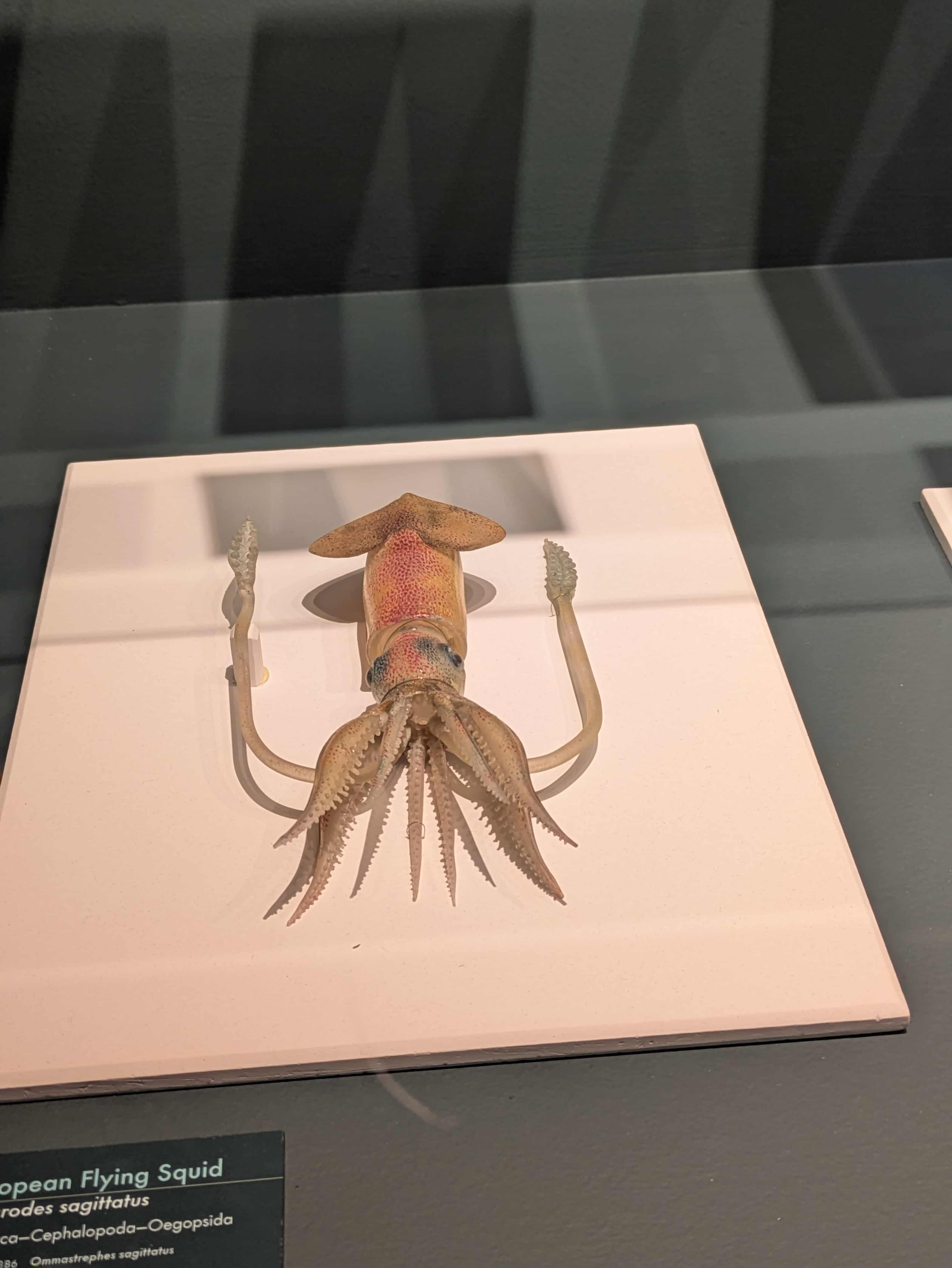
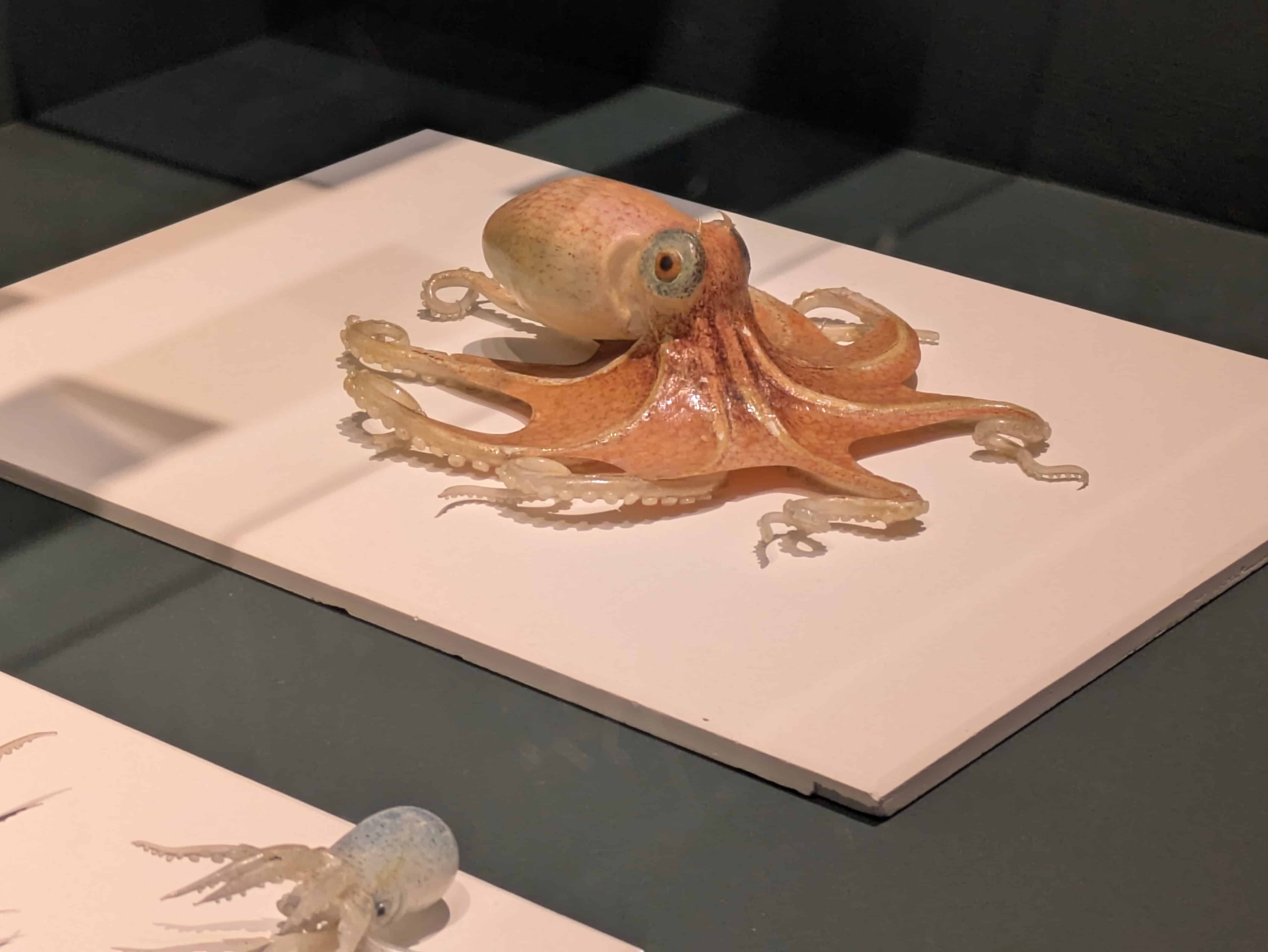
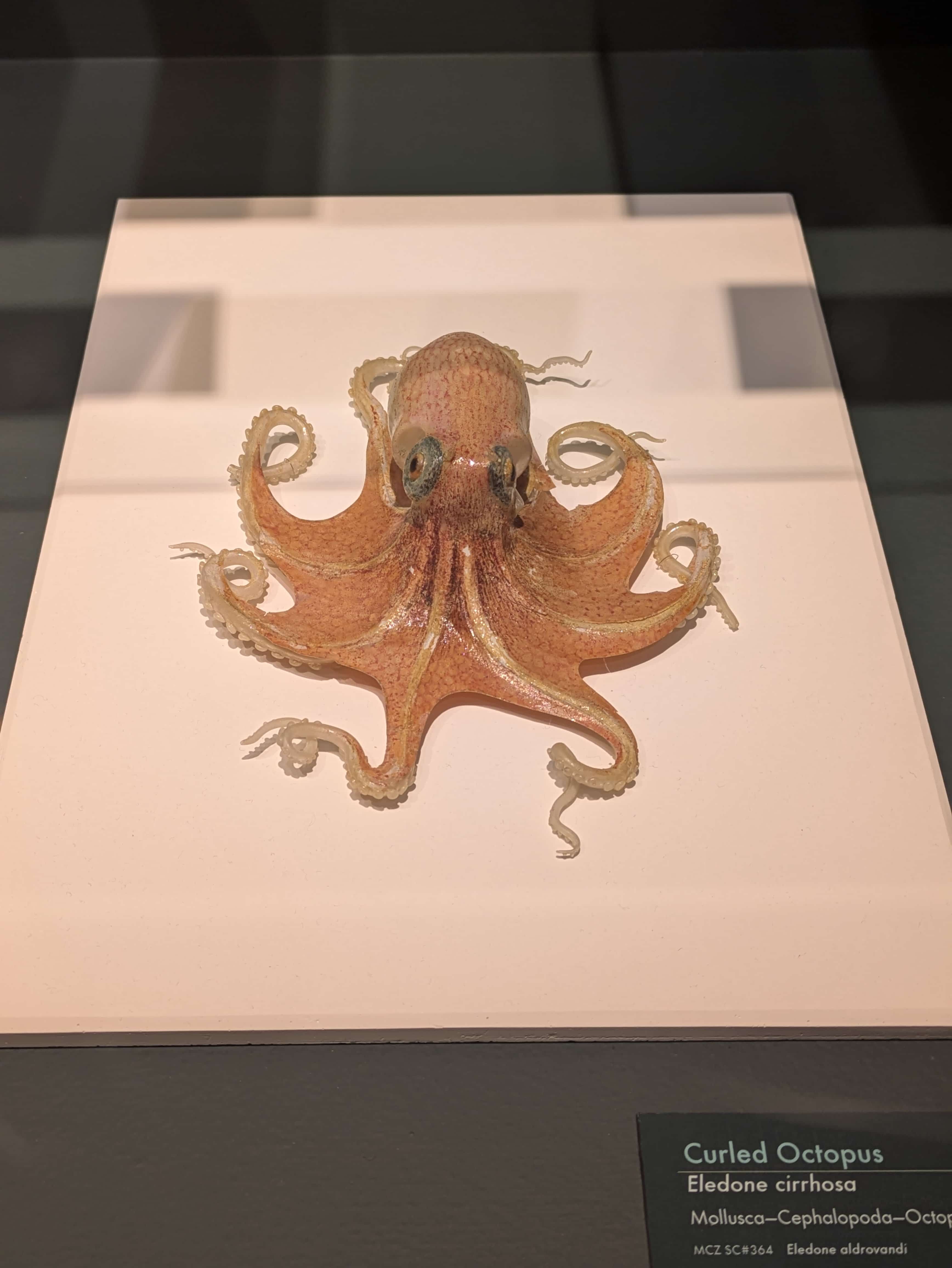
That's a squid! Made out of glass!!! And that's an octopus!!!!!!! They're amazing! Gorgeous! Marvelous! Splendid! Lovely! !!!! !!!! !!!! !!!! !!!!
Exclamation marks cannot explain how overjoyed I was to see these. They made the disappointments of the day worthwhile. There were also jellyfish and sea slugs, though I failed to take pictures of those. The squid and octopus had my devotion.
(As an aside, you can view some more photos of the glass sealife here. Cornell has online images of their entire collected of Blaschka models.)
In A Sea of Glass, by Drew Harvell, Harvell describes how the Blaschka sealife collection came to be. A death in the family led to the father Blaschka to travel overseas, where he witnessed jellyfish. He was entranced by their bioluminescence and imagined creating them from glass. (Glass was the family trade). In the 1860s, he was commissioned to make glass anemones for a museum display based on a series of lithographs. Throughout the 1870s, he transitions to ordering preserved sealife, then live creatures.
Harvell's book demonstrates why models of sea creatures from the 1800s still matter. The creatures seen in these models give us a glimpse into the biodiversity that once was, and what creatures may have been lost to time. This also points to the changing makeup of the oceans---during one of his dives, he encounters some jellyfish blooms that show how "the predators that once controlled jellyfish populations are missing from much of the Mediterranean...Not a fish could be seen and certainly not the turtle and sunfish that normally eat the adult mauve stinger [jellyfish]" (chapter 3).